The annual adjustment of the Portland Clean Energy Community Benefits Fund (PCEF) Climate Investment Plan (CIP) has freed up $15 million in climate tax revenue that could be put toward a transportation-related program. On Thursday, the Portland City Council Climate, Resilience, and Land Use Committee will host an in-depth discussion about some of the ideas that have been put forward for how to spend that money.
Right now, the PCEF Committee has recommended switching that chunk of revenue from an electric vehicle subsidy program to a home energy program. But some members of City Council have ideas of their own.
So far it seems the two leading ideas are to put this $15 million toward either transit (to help TriMet stave off service cuts), and/or to make an investment in bicycling. Councilor Mitch Green supports transit funding, and Committee Chair Councilor Steve Novick has made it clear he supports an idea that would boost bicycling.
Last week I reported on a novel cycling promotional concept that Novick has gotten behind. I only shared a snippet of the plan. Today I can share the entire thing.
Dubbed “Bikeable Portland,” this plan is only in a conceptual phase. It’s based off a 2024 memo from Portland Bureau of Transportation (PBOT) Bicycle Coordinator Roger Geller. The new, 5-page document was prepared by PBOT at the request of Councilor Novick who wanted to see a more shovel-ready version of Geller’s plan.
“This project will catalyze
momentum for the next 20 years of biking in Portland by aiming to restore bike ridership
back to pre-pandemic levels.”– From Bikeable Portland concept plan
The gist is that both Geller and Novick believe Portland’s bike infrastructure network is much better than current ridership implies. They see that ridership plummeted while the network got better (since 2010 (when the Bicycle Plan for 2030 was adopted), PBOT has added 160 miles to the bikeway network). That’s in part why Geller has long held the view (of which he’s convinced Novick of too) that the mantra “build it and they will come” hasn’t really panned out.
Since bike infrastructure has improved at the same time ridership has declined, Novick told me last week, “we should at least consider some non-infrastructure ideas.” That’s how we got to this Bikeable Portland concept.
The idea is to focus on encouraging Portlanders to use what we already have. For example, in its proposed budget, the plurality of funding in the concept plan would go toward paying organizers to offer neighborhood rides. Imagine hundreds of mini Sunday Parkways all over town, each one hoping to light the spark in participants so they’ll keep riding on their own.
According to the concept plan, Bikeable Portland will, “Catalyze momentum for the next 20 years of biking in Portland by aiming to restore bike ridership back to pre-pandemic levels.” Below is more about the goals of the project:
As proposed by PBOT’s bicycle coordinator, the goal of this project would be to ignite and sustain the momentum we once had for making Portland bikeable by leveraging and celebrating our progress in building Portland’s world class bike network. The project’s intent is to get more people to choose to bicycle by focusing on three mutually reinforcing actions:
- Igniting a civic conversation about the ease, desirability and benefits of biking and Portland’s commitment in continuing to advance as a bikeable city.
- Creating consistent opportunities for Portlanders to get support in biking.
- Celebrating over two decades of a strong, vibrant, and inclusive bike culture.
Bike Together
The excerpt I shared last week was from the “Bike Together Program” element of the plan. The idea is for PBOT to contract with an organization who will hire coaches to lead rides. These ride leaders would fan out systematically across each neighborhood and would be responsible for organizing daily bike rides from set locations at set times. Imagine adult bike buses springing up citywide as word spreads between neighbors.
The city believes (and they have a lot of experience doing this type of work), that depending on the budget and scale of the effort, this could reach up to 181,000 Portland households in the target area which the city has defined as: Central City, Interstate Corridor, Lents-Foster, Montavilla, Hollywood, MLK-Alberta, Belmont-Hawthorne-Division, Woodstock and Sellwood-Moreland-Brooklyn.
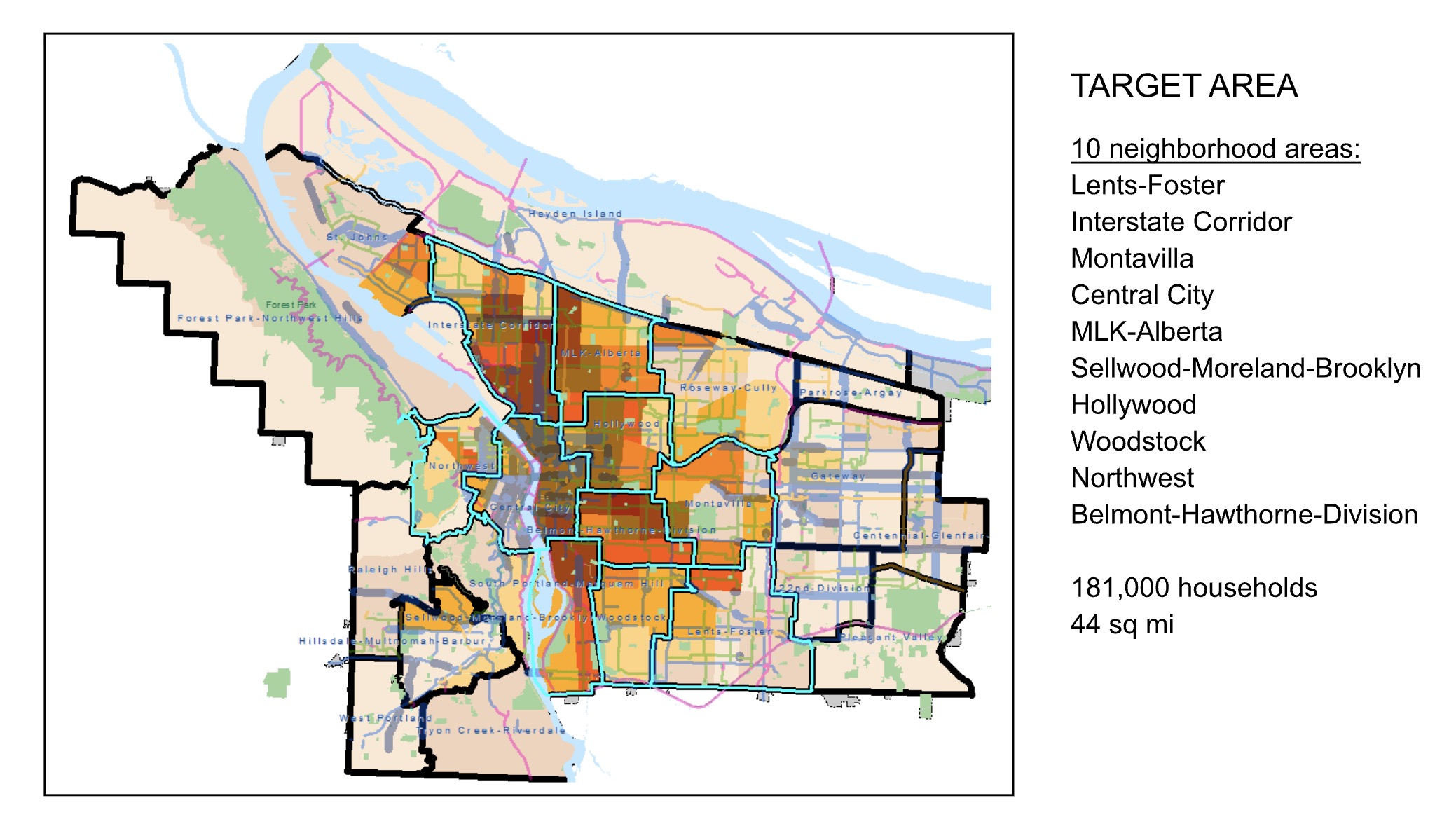
Spark a Civic Conversation About Bicycling
The proposal would also take steps to spur a more robust, citywide conversation about bicycling. PBOT and its partners would do this in two main ways: using pavement markings and hosting cultural events.
The plan calls for doubling the number of “sharrows” (shared-lane markings) currently being used on Portland’s streets in order to elevate the visibility of the existing network. There would also be another type of special temporary markings installed with an aim to, “encourage people to change behaviors where/ when they can.”
The plan would sponsor, host and encourage events designed to, “Celebrate Portland’s determined history in creating a comprehensive network for bicycling, encouraging use of that network, and supporting the shaping of a culture that invites citywide uptake of bicycling.”
Branding, Storytelling and Evaluation
This element of the project would create a Bikeable Portland website whose main goal would be to, “elevate individual voices from community members and political leaders and give people the opportunity to share what a bikeable city means to them.” This part of the campaign would also include marketing materials like fliers, mailings, and billboards.
As these activities are going on, PBOT would do several, “relatively simple and affordable capital projects” in the target area. PBOT wants to make a few key bikeway upgrades in a way that bolsters their encouragement efforts. Here’s more from the concept plan:
These are projects that can be undertaken to improve conditions for bicycling in the project area and that will enhance other supportive encouragement efforts. The bikeway network in much of the target area is formed by neighborhood greenways. Those greenways include known areas of higher-than-desired traffic volume. Areas like SE 21st between Clinton and Division, SE 16th between Stark and Sandy, SE Ankeny between 3rd and 6th. Similarly, E Burnside between 73rd and 94th are sub-standard bikeways for this critical connection between inner SE / NE and East Portland.
Diverters and improved bike lanes in such identified hot spots will be the focus for this flexible capital funding. This program area can also augment encouragement by providing bicycle access for the specific events and activations called out in this project.
At this very early, conceptual stage, PBOT sees Bikeable Portland as a three-year plan. 2026 would be used for set-up and prep and the full effort would kick off in 2027. That would bring us up to 2030 — the end date for the Bicycle Plan we adopted 20 years ago.
This would be a very novel plan with some very innovative elements. But it wouldn’t be totally foreign to PBOT, an agency with decades of bicycle marketing and promotion under its belt. And it wouldn’t necessarily require the full $15 million that’s being debated right now. Depending on scale, PBOT could launch this for as little as $6 million and then consider expanding later depending on how it works (or doesn’t).
Even if it doesn’t get adopted this time around, it opens up some interesting conversations about how to increase ridership going forward.
I’m curious what you think about it now that it’s a bit more fleshed-out. And keep in mind, Councilor Novick told me he’ll read the comments before Thursday’s meeting.