Back at it, the peloton tackles the longest stage of the race with some tricky climbs in the finish. The sun should be back.

Le Printemps de Bourges: the crosswind stage came two days later than planned. A three-quarters tailwind out of Bourges encouraged the peloton to race hard from the start and the script for the racing was gone with the wind. Out went the idea of a close race where the team time trial would shape the GC, where riders would contest the stage in an uphill sprint.

Kévin Vauquelin and Oscar Onley and were out of the GC race, Vauquelin missing the split right at the start while a Onley crashed and lost contact with the front group.
Alas out went Juan Ayuso in a different several riders fell on a bend and if Ayuso was soon back on the bike he could hardly pedal and when he came to a stop he seemed unable to stand up and collapsed to the ground. Brandon McNulty was also out.

This crash split the field and suddenly there were five Red Bull riders on the front with Mathias Vacek and Jonas Vingegaard on their wheels. Vacek would crack and it was down to the Van Dijke brothers to tow Dani Martinez with Vingegaard along for the ride.

Vingegaard did not expect this kind of stage and one clue was his clothing, he was dressed in many layers and could not stop to take them off and so had to race the heated finale with bib longs over giving him the appearance of a runner who had decided to practice for a triathlon. As unfashionable as it seemed, he was looking good as Red Bull towed him away and the time gap on the rest was widening. Nobody behind had any team mates left and the race began to look like some endurance event with everyone out for themselves. Vauquelin was trying to make up for lost time but in the fog of sport Georg Steinhauser had got ahead and so the German is a surprise in the top-10 on GC.
Vingegaard rode away for the win and almost uncontested, Martinez presumably tetanised by the cold. For all Vingegaard’s wardrobe choices he’s the one in the yellow jersey now.

Taken away by paramedics Juan Ayuso looked in a very bad way but the news overnight is more encouraging, no fractures. Things might be more difficult on the Ineos team bus with Vauquelin accusing a Soudal-QS rider of flicking into the ditch at the start. The unsaid part is that he ended up chasing a lone for a long time while the team were trying to help Onley only for Vauquelin to ride past and be their first finisher but in the moment this outcome was hard to predict earlier and to go back and “rescue” Vauquelin would have been perilous.

The Route: 205km and 3,000m of vertical gain. It’s south down the Saone valley and into Paul Seixas country as he’s from the north of Lyon where the first climb of the day is a small bump in the road; the next one out of Trèves is a long drag.
Things get tricky with 40km to go. The climb to Sécheras has a tricky start with several corners in the village beside the Rhone river where positioning counts. It’s 4km at a solid 7% and all on a small back road. There’s a bigger road but only just to go back to the valley floor.
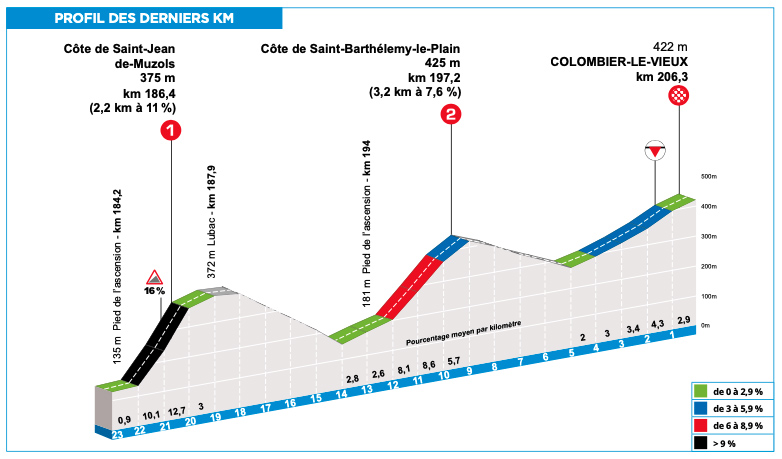
The climb out of St. Jean-de-Muzols is 2km at 12% and if the graphic above signals a 16% section, there are good parts at 15% on the way too, and all on a road that quickly gets narrow. It should be the decisive point of the stage.
The next climb is a bigger road with steady gradient and then a right turn for a smaller road to the finish that drags up before levelling out just by the finish line.
The Contenders: a lot depends on who has recovered yesterday. The breakaway has a good chance because if Vingegaard leads the race, he’s in a relatively secure place for now and there are only three others within five minutes on the GC although Visma are bound to filter the breakaway to ensure nobody is allowed back into contention.
Ivan Romeo (Movistar) has seen is GC bid collapse so now switches to stage hunting and he climbs surprisingly well. Ewen Costiou (Groupama-FDJ) is a punchy rider for the finish. Lennard Kämna (Lidl-Trek) has to race for himself now. Nicolas Prodhomme (Decathlon-CMA CGM) is no GC threat.
Kévin Vauquelin (Ineos) might feel he has a point to prove today, maybe Oscar Onley too. Lenny Martinez (Bahrain) will want a result this week and today’s stage suits.
Sandy Dujardin (TotalEnergies) is the local rider.
 |
– |
 |
L Martinez, Romeo, Soler |
 |
Costiou, Kämna, Vauquelin, Onley, Arrieta |
Weather: the Mistral wind can howl down the Rhone valley but usually it’s further south and the forecast says it won’t blow much anyway, just a 10km/h tailwind. Otherwise 11°C but sunny.
TV: the finish is at 5.00pm. Tune in from 4.00pm to get the final steep climbs.
Postcard from Tournon-sur-Rhône
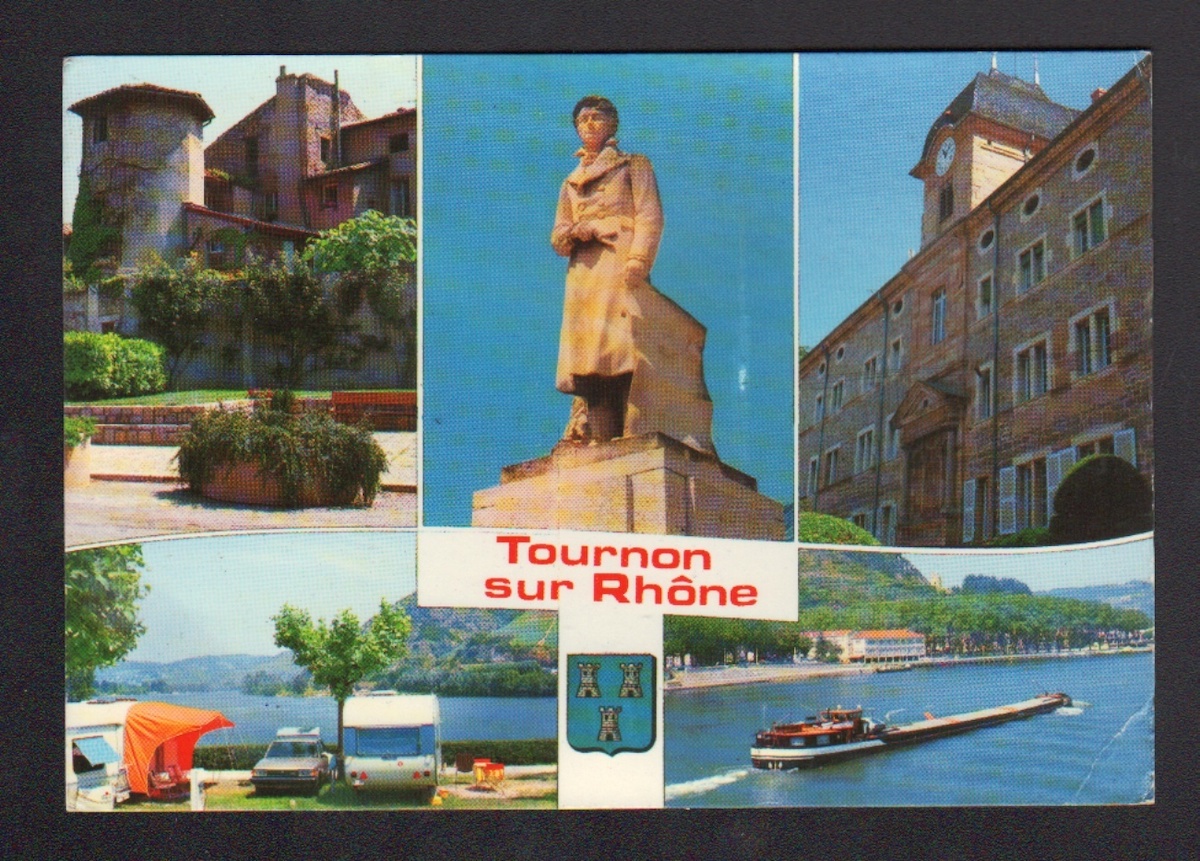
Paris-Nice goes down the Rhone valley today and this overlaps with plenty of past editions, including the 1959 version. Its long-time organiser Jean Leulliot had a history of innovation (the Tour de France féminin, the prologue, the kilometre rule, the air transfer were some Leulliot’s ideas and he had plenty more). But one change he was against was radio course, “race radio”. The short wave system allowed those in the race convoy to communicate. It had been introduced in the 1956 Tour de France which Leulliot covered as a journalist and here is part of his write-up:
“Just push a button and everyone: team managers, journalists, photographers can get the innermost details of the race. For example one day you can hear “Ride X alerts his manager that has found some ham in his musette!” It was evocative but really useless. The reach of Radio Tour must be limited”
– Jean Leulliot (translated) in Sport Mondial, 1956
Leulliot didn’t just want the radio’s signal power kept low, he was against it for several reasons. First because it didn’t work on some days and so nobody knew what was going on because with radio they’d got rid of the blackboards used to communicate time gaps. But when it did work Leuillot wrote that it took the thinking out of a race, that directeur sportifs would be reduced to robots.
Leuillot’s next objection was that any local en route could pick up the signal and feel informed; but this could wrong as as race radio was run by the organisers and not news mediated by journalists.
All of Leuillot’s complaints were about race radio in the convoys but you can see obvious parallels to team radios used today which riders carry with them: the claims of robot riders guided by operators from the team cars; or the audio clips of this played in the Tour de France which are supplied by the organisers rather than journalists.
However if Leuillot was against this as a journalist, he was an organiser as well and radio course became a component of the sport. In 1959 he relented and Paris-Nice went on the airwaves too.