What’s better than an early morning ride when you have the roads mostly to yourself?
Well, probably plenty of things, but it’s still pretty far up there.
Sometimes when you ride early you see all the litter people left the night before, but in this case all the detritus was all natural, as a quick and violent storm had torn through the area like a giant weedwacker and left downed trees everywhere:

Fortunately there’s sort of a little ditch running along the path and the runner and I were able to scurry chipmunk-like beneath this one…though my scurrying was somewhat limited by the fact that I was wearing road-style clipless shoes for the first time in quite awhile:

Notice I continue to employ the much-maligned red hoods on this bike–not because I think they look good, but because I am employing an evolutionary tactic called “aposematism:”

Coupled with the 23mm tires, the effect is that I successfully repel gravelistas, “alt” cyclists, PNS jersey-clad nü-Freds, and any other type of cycling fashion victim I’m likely to encounter.
In addition to being a mix of unappetizing colors, the Faggin is also a bllend of old and new tech, and hilariously The Guy Who’s Been Reviewing Bikes For 25 Years thinks cyclists aren’t treating the latter fairly:

I realize this is an opinion piece, but there are a lot of problems here. For one thing, yes, he’s right, you don’t have to use the new tech…just as long as you’re content with the bike industry constantly phasing out the tech you’re currently using. I can certainly choose to keep riding the Faggin, and used parts that will work with it are not going to disappear within my lifetime, but that does not change the fact that the bike industry has more or less decided not only to stop making bikes like this, but also to stop supporting them, which I’d argue is a net loss for humanity.
Another issue is that Warren constantly reminds us he’s been testing bikes for 25 years, but here he says he’s been “involved with bikes” for nigh-on (that means “almost”) 30 years:
It seems nothing has changed in the nigh-on 30 years I’ve been involved with bikes. Every type of new tech introduced has been met with equal parts excitement and disdain from the cycling community.
This means that prior to testing bikes, Warren was involved with them for at most 4.9 years…which is really not enough experience to be telling other people what to buy, if you ask me*.
*[Disclaimer: by reading this blog, you have effectively “asked me,” which means you are going to get my opinion on a wide range of subjects, from the merits and drawbacks of various types of shifters to my thoughts on the eternal Kirk vs. Picard debate.**]
**[Disclaimer: I don’t care about either of them, and if I must choose a captain then my allegiance is with Captain Stubing, or if he is incapacitated, Captain Kangaroo.]
Warren then proceeds to prove his paucity of proficiency with a procession of profligate pronouncements, such as this one:
When suspension started to arrive in mountain bikes, it was decried as a heavyweight, expensive fad, before becoming integral. That pattern has been repeated multiple times over the intervening years.
Good grief Warren, bicycle suspension is a heavyweight, expensive fad! Surely you remember this bike from 1999:

Back then it was cutting-edge, and reviewers lauded its performance. One publication even said the following:
This bike is virtually mistake-proof through technical sections.
Yet here we are in 2026 and the common wisdom is that this bike is not only obsolete but downright dangerous to ride.
Oh, sure, you’re going to say suspension isn’t a fad because we’re still using it and the bikes are “dialed in” now. But that’s true until precisely the moment it isn’t anymore and something new comes along. Today’s Pivot/Transition/Whatever is tomorrow’s GT iDrive.
None of this means suspension is bad–obviously it makes certain types of bikes better for certain types of riding–but it would be refreshing if people would at least be honest about how its shelf life should be measured in hours just like its service intervals.
Speaking of mountain bikes:
I remember having conversations in the office around disc brakes on mountain bikes, arguing we didn’t need them because V-brakes were so good.
But…but…WE DON’T NEED THEM. No, I’m not saying disc brakes are bad. Yes, disc brakes really do make some types of bikes better. But conservatively speaking, 50% of mountain bikes do not need disc brakes, plenty of people would be just as well if not better served by the simplicity of v-brakes, and the fact that they’ve now gone the way of the cantilever is simply astonishing.
I suppose this is where people like Warren get confused; it’s not that people think the new stuff it’s bad, it’s just that they know it means the bike industry will soon completely abandon the “old” stuff, even if it’s still really good. Consider the STI lever:
The same happened with STI levers on the road (complex and expensive).
Warren.
Warren, Warren, Warren.
THEY ARE COMPLEX AND EXPENSIVE.
Yes, I like them. Yes, I use them. Yes, they work well and are generally quite reliable:

They’re also more expensive, more complicated, less versatile, and conservatively speaking 50% of drop bar bikes don’t need them. Sure, they’re better for race bikes, but does that mean options like this have to completely disappear?
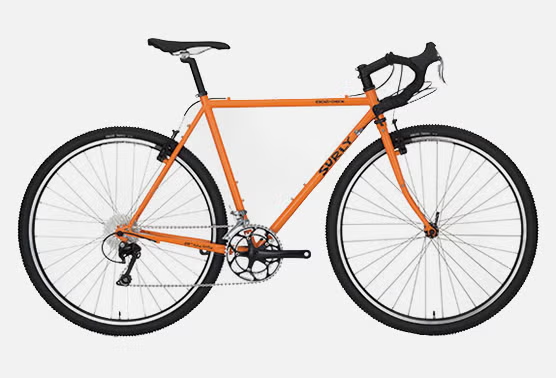
I mean I guess if people aren’t buying them they’re not going to keep selling them, but did people really not want them anymore? Or is it because if you were shopping for a bike and you were reading bike reviews they’d make you feel like any bike that didn’t come with STI levers was automatically a piece of crap?
And don’t get me started on the crabon, Warren. DON’T GET ME STARTED.
Meanwhile, carbon fibre frames were apparently only good for one season and then they’d ‘go off’.
Too late, he got me started.
Is crabon bad?
No, it’s not bad.
In fact, depending on what you actually need out of a bike it may be fantastic.
But crabon absolutely does “go off:”

Sometimes after a single ride!

And yes, the anti-crabon propaganda content I’ve linked to is from a company that makes expensive titanium frames, but hey, what’s wrong with a little confirmation bias every now and again?

Also, I’m not afraid of crabon bikes. I rode a nearly-40-year old one across Switzerland after packing it a cheap nylon bag. If you want a light bike that goes fast then crabon is a good choice–maybe even the best one for you. But you also need to keep in mind that it could very well end up being a one-season bike. Yes, the odds are in your favor that it won’t, but you also can’t get away with treating it the way I’ve treated that poor Faggin.
As for this one, it hardly even warrants a mention.
Electronic gears and road disc brakes still have their detractors.
It’s a shifter…that requires…a battery.
And this is just crazy:
On mountain bikes, it was the 26in wheel versus 29in, and not forgetting 27.5in (650b), wheel wars.
Look, citing the last time people like you have told us a wheel was better only to abandon it completely is not helping your argument.
And yet…
And now we’re going through the same debate with the latest advance in bicycle tech, 32in wheels, which are beginning to appear on mountain and gravel bikes, spurring the vitriol of many commentators.
It’s the same old tropes. The ‘industry’ is seen as forcing something new on the unsuspecting public, as if it’s some singular hive mind. However, that’s far from the truth.
Though even Warren seems to understand how niche this new wheel size is:
This isn’t to say 32in wheels don’t have any downsides. You need to think about gearing choices, for one thing. But most importantly, because the wheels are significantly larger than 700c, it’s not a one-size-fits-all proposition either. If you’re shorter than around 5ft 10in, I don’t think the wheel size will be right for you.
I think taller riders will embrace it, though. I have a couple of riding friends much taller than me (I’m 6ft 2in), who’ve always struggled to find bikes that fit, and even when they do, they’re not exactly good-looking.
A quick Internet search suggests that a mere 15% of the adult population here in West Greenland is taller than 5’10”, and almost all of them are men. (Only something like 2% of women are taller than that.) So sure, it’s not a bad thing that tall guys can opt for a bike with larger wheels, but when you think about it, the fact that they’ve gotten this much attention when such a small number of people will have any use for them is completely insane.
So to sum up:
- New stuff = good
- Choice = good
- New stuff completely replacing old stuff that was still really good = bad
And finally, speaking of the passage of time, witness the evolution of Manhattan’s fastest bike messenger:
Eventually he slowed down, kinda:
Sort of amazing that when I started this blog there was still such a thing as a “bike messenger.”