Yeti broke from its longstanding Switch Infinity design when it debuted its Sixfinity six-bar suspension platform on the 160e eMTB a few years back. They’ve since incorporated the platform on the LTe and MTe, and today, the brand is introducing its first non-electric model built around Sixfinity; the 160mm-travel LT. The LT replaces the SB160 as Yeti’s hard-hitting long travel enduro bike, and along with the new suspension platform, it gets an updated look, longer/adjustable rear-center lengths, in-frame storage, and more.
I was very impressed with the LTe when I tested it, so much so that I was hoping Yeti would eventually incorporate Sixfinity into one of its non-electric models. I was happy to find out recently that the folks at Yeti felt the same way and were coming out with the new LT. I was even happier to get my hands on a test bike a couple of weeks ago for some pre-launch testing. I’ll start by covering all the important details about the LT and finish with my first impressions of this exciting new bike.

Yeti LT Details
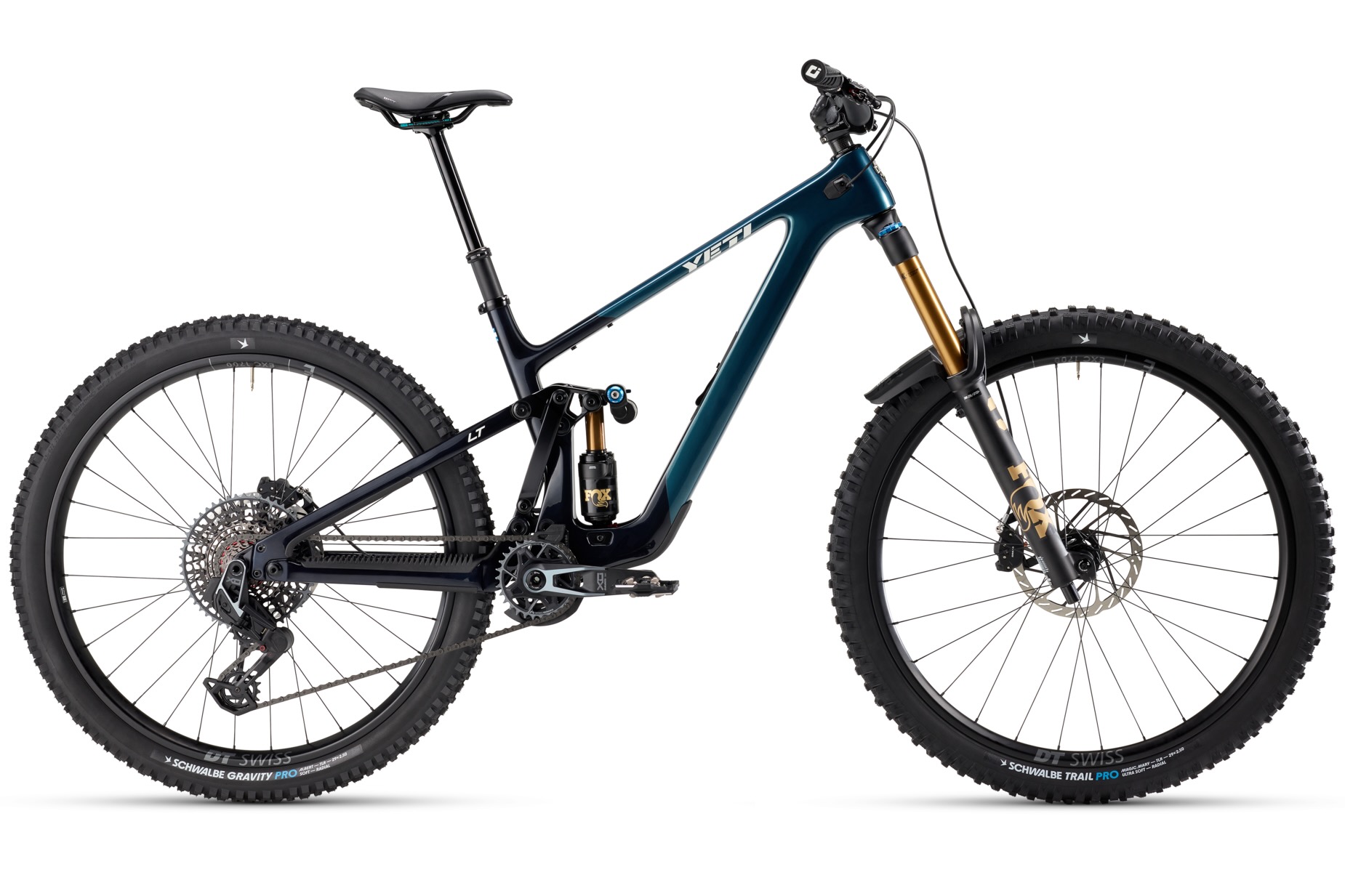
The new Yeti LT is a lot like the LTe, just without the “e”. It shares the same travel, suspension platform, similar geometry, and distinctive Yeti looks as its electrified sibling, minus the bulk and weight of the e-bike components. With 160mm of rear wheel travel and 170mm in the front, it replaces the highly decorated SB160 as the enduro race bike in the brand’s lineup. Arguably, the biggest story with the LT is the move to the Sixfinity suspension platform, but there’s plenty more to it than that. Let’s check it out.
Frame Design
Yeti is making the LT frame in its high-end TURQ Series carbon fiber only and includes Vectran reinforcement for durability and impact strength. The frame gets 160mm of rear wheel travel and comes with a 170mm fork. It rolls on 29” wheels front and rear, and is compatible with a 27.5” rear wheel (MX) with a wheel size flip-chip that maintains geometry. Another flip chip allows riders to make minor changes to geometry in the MX wheel configuration only.
Yeti went all-in on size-specific rear center lengths with the goal of optimizing front and rear balance across all frame sizes. Rear center lengths start at 439mm on the small frame and increase incrementally up the size run to 465mm on the XL. Additionally, Yeti includes swappable bolt-on dropouts, giving riders the option to increase rear center length by 10mm to suit their handling preferences. At the front of the bike, the ZS44/56 should make it fairly easy for riders to install aftermarket angle or reach-adjust headsets.

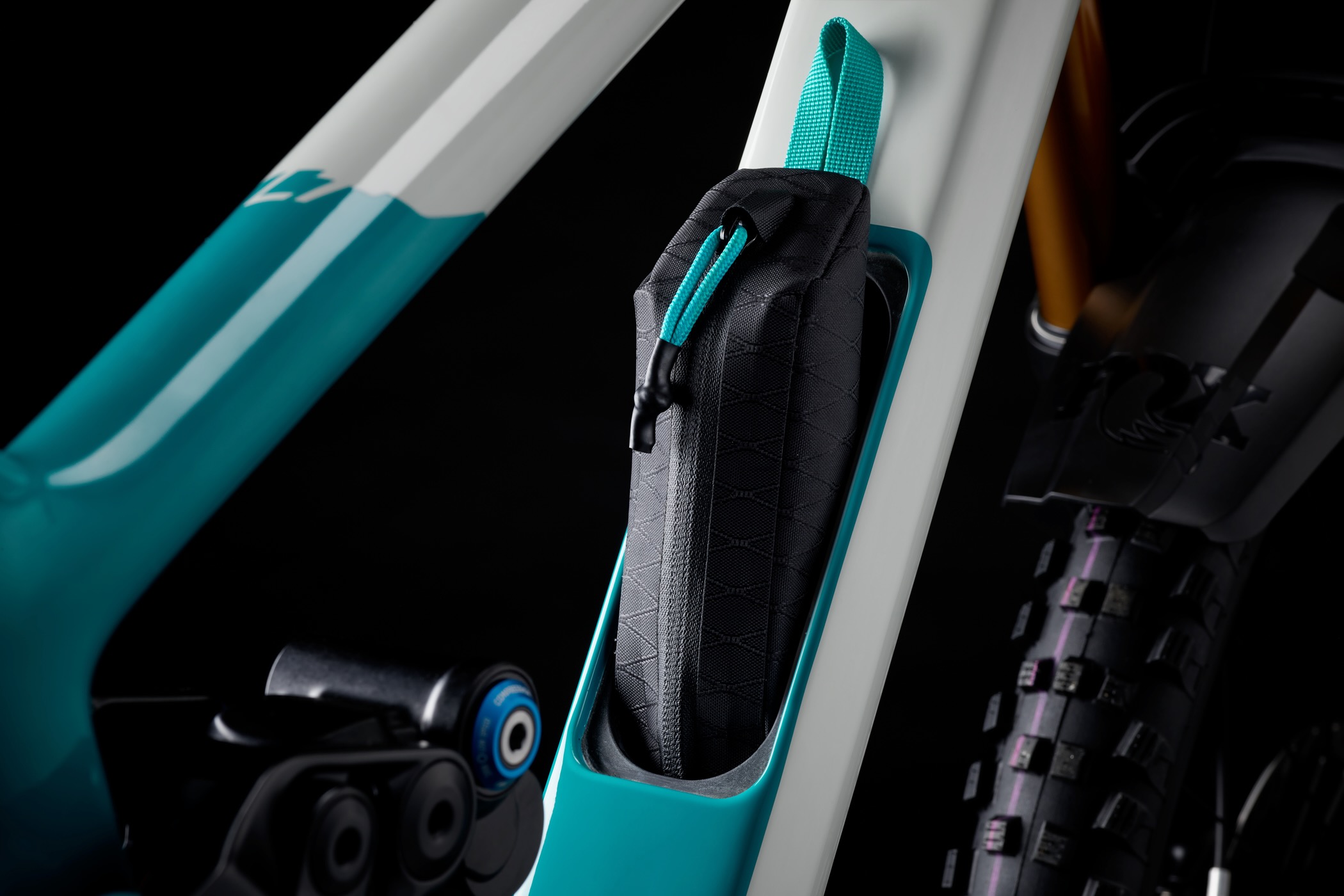
On the LT, Yeti also added an in-frame storage compartment called The Cavity. The plastic door has a set of bottle mounts and uses a CNC-machined roller cam lever to secure it. The Cavity comes with a single zippered frame bag for tubes, tools, etc. Yeti included another set of mounts on the underside of the top tube to bolt on another accessory or tool. There’s a large frame protector on the downtube, which includes a spot to stealthily hide an Airtag or similar location-tracking device.
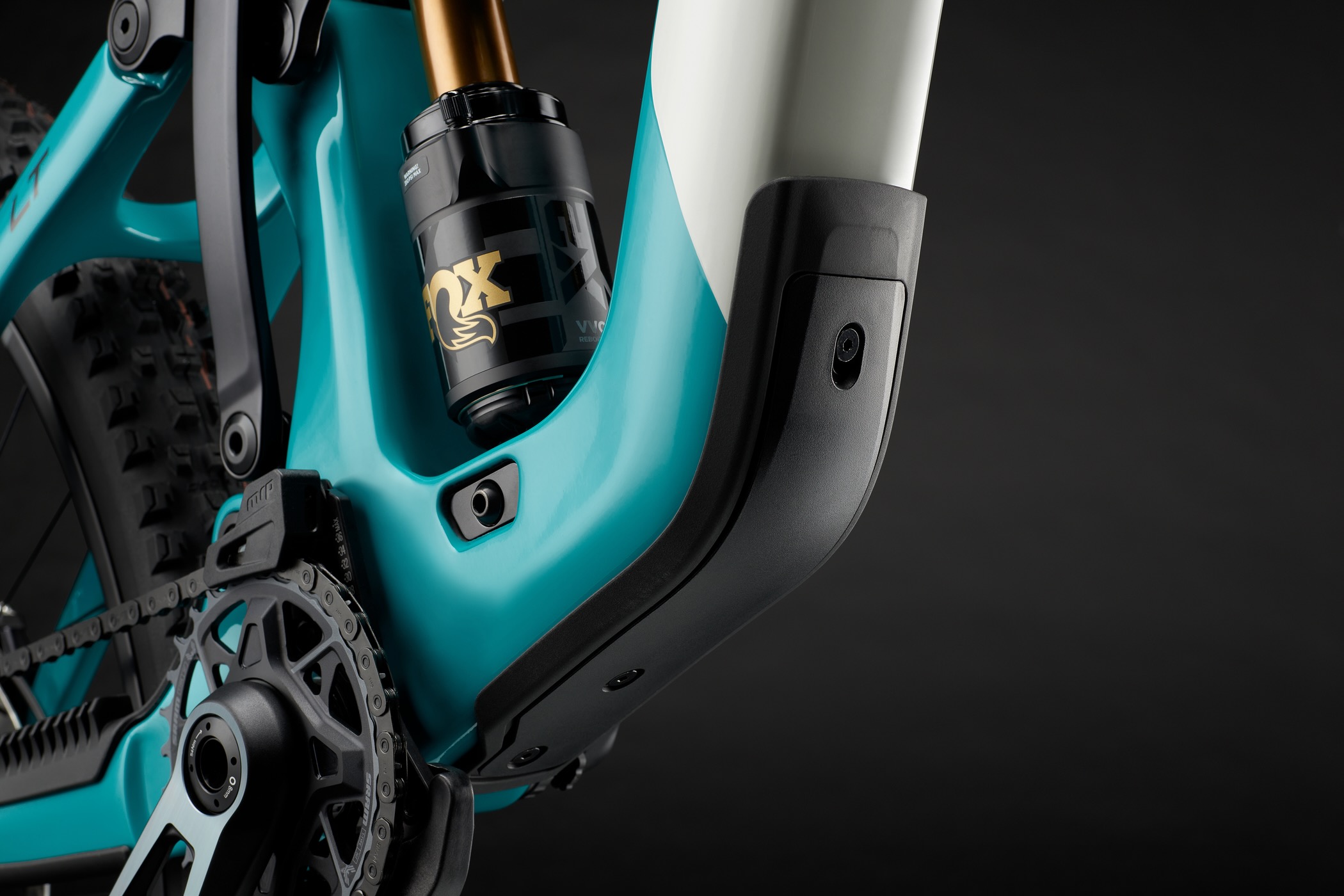

Cable routing is internal with bolt-on cable capture ports on the frame and guided tubes for ease of maintenance. There’s updated rubber protection on the chainstay and seatstay, and complete builds come with an upper chain guide and a bash guard. The frame has a threaded bottom bracket shell, Boost axle spacing, and has been designed with long dropper posts in mind.
Sixfinity

Debuting on the 160e a few years back and used on the LTe and MTe eMTBs last year, Yeti’s Sixfinity suspension was a major departure from its Switch Infinity design. According to Yeti, the engineering team has been tinkering with and developing a six-bar suspension design since 2016. After the high praise both the MTe and LTe have received, the brand finally decided to incorporate Sixfinity into a bike without a motor.
“The LT combines our learnings from 15 years of Switch Infinity, 10 years of Sixfinity exploration, and a long-term commitment to racing. Maintaining the best attributes of Switch technology, while executing an array of kinematic, structural, and size-specific geometry improvements that Sixfinity makes possible: These are changes that are not just for the sake of change, but aimed for tangible performance gains to make all riders faster. It is a big step towards a never-ending pursuit that we are excited to see the riding community enjoy.“
– Peter Zawistowski, CTO, Yeti Cycles.


Sixfinity is a six-bar linkage that Yeti says allows the engineers to independently control the three key kinematic metrics: anti-squat, anti-rise, and leverage rate. Yeti refers to anti-squat as “acceleration response,” and it has been tuned around sag for pedaling efficiency, before dropping off sharply for descending performance. Anti-rise, or “deceleration response,” stays relatively consistent throughout the travel range with the goal of balancing traction and geometry preservation while braking.

Similar to the LTe, the leverage rate is adjustable to 15%, 20%, or 25% with swappable chips at the lower shock mount. This allows riders to choose their desired suspension feel to match their riding style or terrain.
Geometry

With the LT, Yeti is leveraging its years of race-winning bike design experience into what they are calling the “sweet spot of enduro geometry.” Looking at the geometry chart, the angles and numbers are pretty standard for a modern long-travel bike. That includes the 64-degree head tube angle, 77.5-degree seat tube angle, and 485mm reach (size large). As expected for the enduro category, stack heights are also relatively generous.
Where the LT’s geometry really stands out is the aforementioned size-specific rear center lengths. Unlike many size-specific chainstay lengths, which increase in relatively small increments, Yeti really went for it. The significant changes to chainstay length should have a noticeable impact on the fore/aft balance across all sizes. And when you factor in the modular dropouts to add 10mm of length, riders can end up with some properly long rear center lengths.

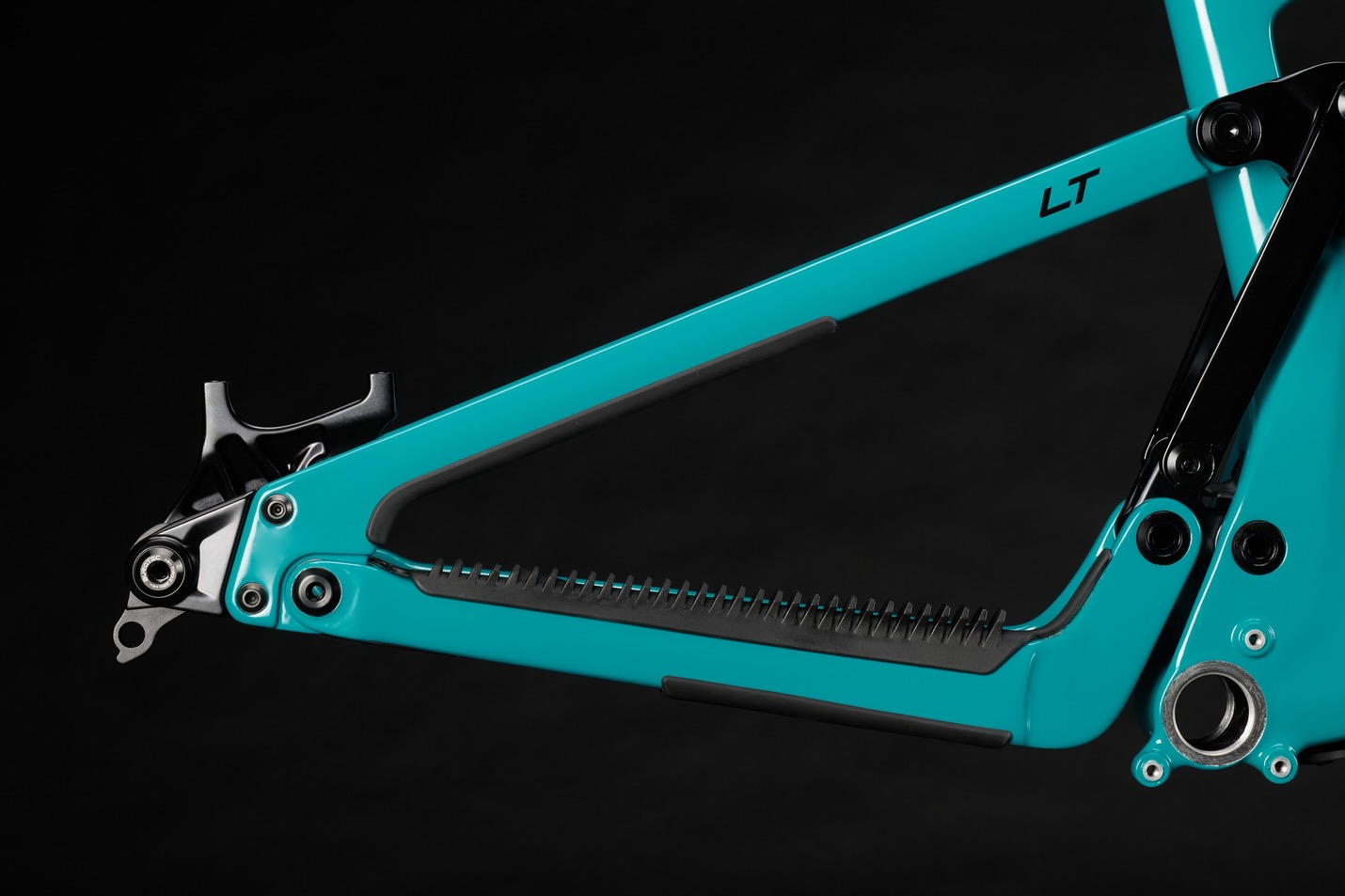
Rear Center Lengths (0mm / +10mm)
- Small: 439 / 449
- Medium: 442 / 452
- Large: 455 / 465
- XL: 465 / 475
It was already touched on briefly, but the LT also has a wheel size flip chip that maintains geometry when switching to a 27.5” rear wheel. In the MX wheel size configuration, riders also have the option to use another geometry-adjusting flip-chip to slacken the head tube by 0.5 degrees and lower the bottom bracket by 6mm. Check out the chart below for the rest of the geometry details.

Builds and Pricing
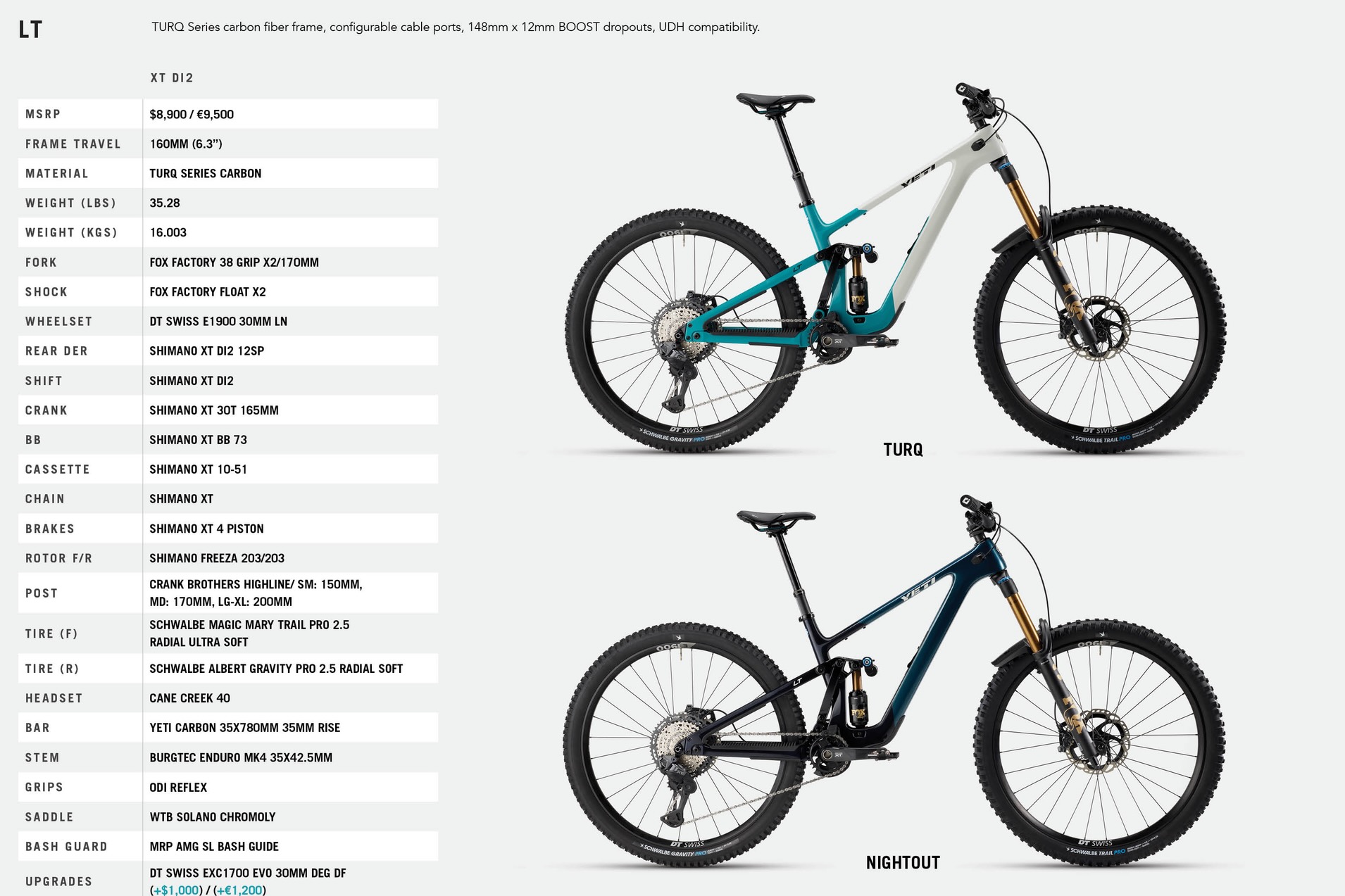
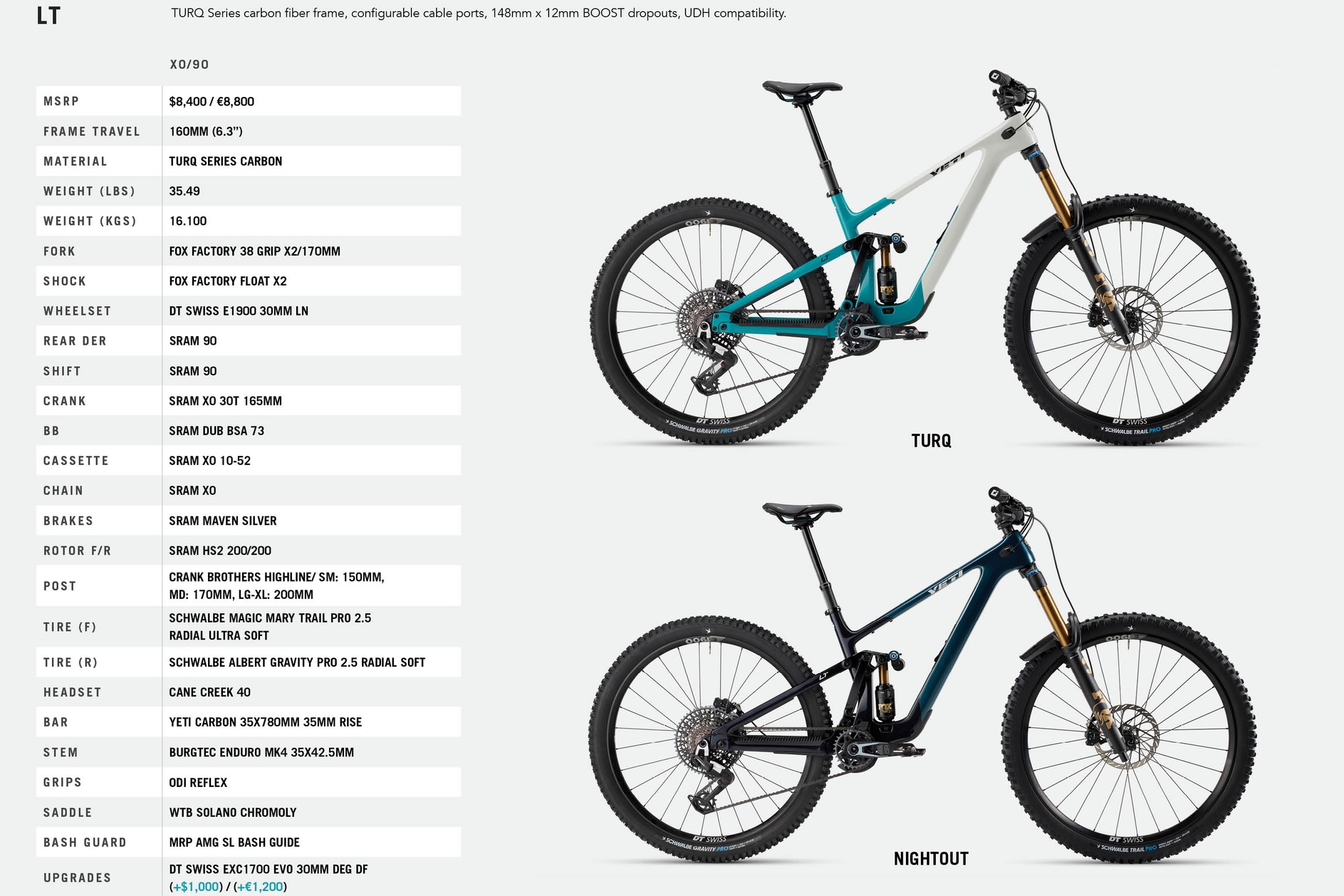
Yeti is offering the LT in three complete builds, all of which are built on the same TURQ Series carbon frame in TURQ (white and Yeti turquoise) or Nightout colorways. All of the complete LT builds come with the same Fox Factory 38 Grip X2 fork, Factory Float X2 shock, and Schwalbe Magic Mary Trail Radial / Albert Gravity Radial tire combo. Click any of the images below to enlarge the specs.
Yeti LT XO AXS: $10,200 / €10,900

Yeti LT XT Di2: $8,900 / €9,500
Yeti LT X0/90: $8,400 / €8,800
Availability
The new Yeti LT is available now. Head to the brand’s website or your favorite Yeti dealer to learn more or buy one of these new enduro race rockets.
First Rides on the Yeti LT

I’ve had the Yeti LT for a little over two weeks now. I’ve got a handful of rides on it so far, but not enough for a full review just yet. I feel like I’ve scratched the surface and am only just beginning to understand what this bike is truly capable of. But just like every other Yeti that I’ve ridden in the past couple of years — the LTe and the ASR — the fit and finish are absolutely dialed, and my first impressions are overwhelmingly positive.
I’ve got the top-of-the-line X0 AXS build in the Nightout colorway. I’m 6’0″, and the large frame is a perfect fit for my lanky body. The 485mm reach is exactly what I’m used to, and along with the steep 77.5-degree seat tube angle, moderately high stack, and carbon Yeti riser handlebar, results in a comfortable seated pedaling position that feels great on fire roads and steep singletrack climbs.

Using Yeti’s suspension setup guide, I was able to find a good baseline for the fork and shock settings. I haven’t deviated too far from the suggested settings, although I adjusted the fork by adding a couple clicks of high speed compression to maintain ride height and opened the low speed compression by a couple clicks to get a more supple, ground-hugging feel.
For the rear shock, I’ve left it in the neutral 20% leverage rate setting and let Sixfinity work its magic. I plan to tinker with the leverage rate chips and try the other settings, but I have no complaints about where it’s at right now. It’s shockingly calm and supportive when seated pedaling but reacts nicely to trail inputs and feels fairly smooth over small bumps and trail chatter. Once you go past the inflection point, it’s super plush in the mid stroke with enough ramp up toward the end of travel to avoid harshness or hard bottom outs.
Sixfinity on the LT delivers the same balanced suspension performance that made the LTe one of the most fun and confident eMTBs I’ve ridden to date. Calling it magic sounds a bit cliché, but it works really, really well, and I think Yeti made a great decision to put it on their long travel pedal bike, too.

My test bike came with the +10mm dropouts installed, giving me a 465mm rear center, which is probably the longest I’ve ever ridden. I kept it in the long setting for the first three rides which included several laps at the Sky Tavern Bike Park, numerous runs on my favorite local steeps, and an XC-ish ride over to the neighborhood jumps and berms. From chunky DH runs and skidders to small jumps and flow, the LT felt comfortable and composed right out of the gate. I found it to be very easy to get along with and confidence inspiring in all situations.
It’s undoubtedly a big bike, and extra long with the +10mm dropouts installed, and that, unsurprisingly, results in a very stable ride and a bike that feels eager to charge the fall line. At the same time, it remained surprisingly maneuverable with an unexpected amount of pop, although slightly reluctant get up onto the back wheel for manuals or wheelies. Still, I was surprised how well it came around in the corners or navigating uphill switchbacks.

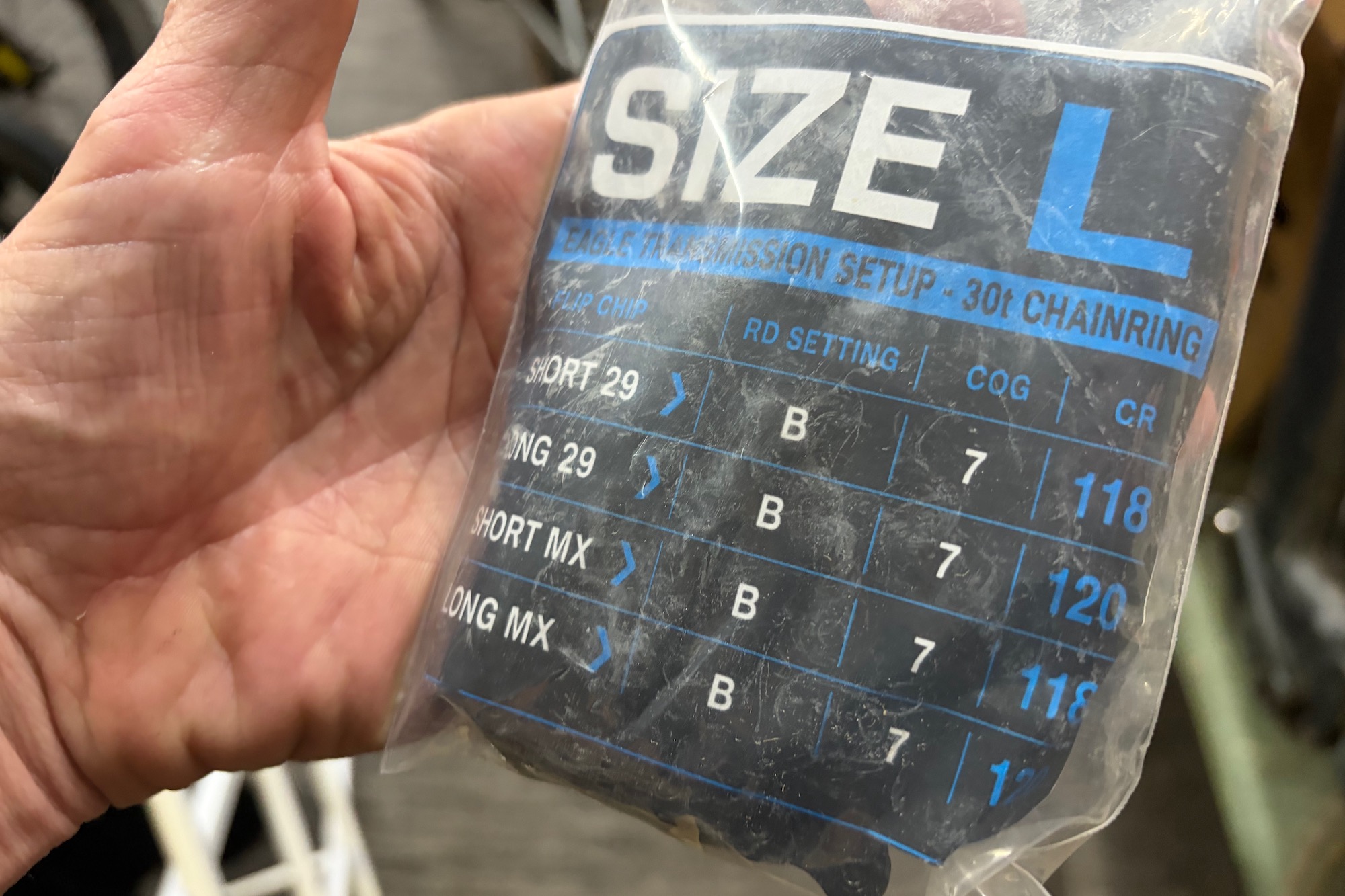
After those first few rides, I swapped over to the “short” dropouts and a 455mm rear center length. Switching the dropouts was pretty straightforward, with the most complicated part being reattaching the Transmission derailleur. It took me about 20 minutes and I was ready to ride. The 10mm difference is significant and definitely noticeable; it’s still very stable but a touch more maneuverable both up and down the hill. It definitely feels a little more playful, and is slightly easier to pull up and manual through dips in the trail.
I think the short dropouts align better with my preferences, riding style, and typical terrain, and I’ll likely leave those on for the foreseeable future. I could see myself switching back to the +10mm dropouts if I know I’m going to be riding some super high-speed trails or for some more back to back testing. Regardless, I like that Yeti gives riders the option on an enduro race-oriented bike like the LT.


The top-tier XO AXS build leaves nothing to be desired and undoubtedly enhances its performance on the trail. Fox’s latest suspension works very well, the Maven brakes offer heaps of power, Schwalbe’s Radial tires provide class-leading grip, and the DT Swiss EXC1700 Evo carbon wheels feel bombproof. The cockpit is also well appointed, with Yeti’s own carbon riser bar, a stout Burgtec stem, and comfy ODI Reflex grips. Out back, the 210mm dropper gets the saddle nice and low — although I could probably fit a 240mm — and the Yeti-branded WTB Solano saddle is one of the best I’ve used in recent years. My test bike weighed in at 36 pounds set up tubeless, without pedals, but with an Arundel bottle cage, which seems pretty reasonable for its travel length and spec.
Not that style matters, but I think the LT is a damn good-looking bike, too. Its got clean lines with a thinned out top tube, and very minimal branding compared to previous Yeti bikes. I was also impressed with how quiet it is, with no cable rattle, minimal chain noise, and no rattling from the in-frame storage door. The Cavity door cover latches very securely, and the storage bag is fairly easy to get in and out.


Overall, my first impressions of the Yeti LT are that it’s a very confident and capable ride, and a step forward in the evolution of the brand’s enduro race machine. I imagine that moving away from Switch Infinity isn’t easy, but Sixfinity has already been very well-received on Yeti’s eMTBs and, in my opinion, represents a step up in performance. I’ve been having a great time riding it so far and I’m looking forward to putting plenty more miles on it before giving it a full review.