The winning moment? No, rather than a breakthrough decisive moment, this Giro d’Italia gave us repeat results across multiple mountain stages. Jonas Vingegaard would attack mid-climb, Felix Gall would briefly give chase before deciding otherwise while the rest paced themselves as best they could. Each mountain stage felt like a Bayesian exercise in confirmation every each test brought the same result from Blockhaus to Piancavallo.

The race started in Bulgaria. These grand tour starts can be expensive, the value questionnable. But we got to see the country and watch Paul Magnier take his first win in a finish marred by a crash that blocked the whole road.
The next day another crash and more traumatic. It took out Jay Vine, Marc Soler, Santiago Buitrago and Adne Holter; the next day Adam Yates and Andrea Vendrame did not start. If UAE started without João Almeida, now their second GC rider was gone.

After a brief neutralisation things restarted. Vingegaard lead up the sharp climb out of Lyaskovets, at first it just looked like he wanted to be out of danger but he accelerated. Only Giulio Pellizzari and Lennert Van Eetvelt could follow him but they were all swept up in the finish. With hindsight this was tantalising moment, Vingegaard hustling for time but he’d soon prove more measured.

Thomas Silva won the stage, the first of several surprise winners; one theme. Another was that a handful of riders won most of the stages. Paul Magnier won again in Sofia. He, Vingegaard and Jhonatan Narvaez would win half the stages.

With the race back in Italy Movistar set the pace on the Crocetta pass to Consenza and popped all of the sprinters except their house fastman Orluis Aular. Only for UAE to have numbers in the finish too and Narvaez won the stage, the first of three wins for him.

The next day saw Igor Arrieta win ahead of Afonso Eulalio in a slapstick ending. Wet roads on day of biblical rain saw Arrieta and Eulalio take turns to crash and remount, as if there were banana skins on a Mario Kart route. Just as it looked like one was clear for the win, they crashed and the other surged past and so on. Live bookmakers must have made small fortune. Arrieta eventually won but Eulalio took the maglia rosa which he’d keep until Stage 14.

Eulalio’s time in pink suited Vingegaard as Bahrain committed to riding on the front of the peloton but with hindsight – which is what a blog review is for – giving the Portuguese rider such a lead meant he’d win the white jersey in Rome at the expense of Davide Piganzoli. It’s not like Visma could have adjusted a dial to give Eulalio less of a lead and his riding exceeded expectations but there are trade-offs when renting out the lead too.
Davide Ballerini won in Naples with a finish that everyone who saw the course thought “that U-turn on the cobbles before the finish looks risky for a bunch” and sure enough there was a crash even if most stayed upright.

Stage 7 was the longest in the race, a marathon 244km day to the Blockhaus climb on a Giro of otherwise short stages. Jonas Vingegaard attacked from far out. Giulio Pellizzari audaciously gave chase but his oxygen debt came with a hefty interest rate and he could not meet the repayments. Felix Gall came past like a pedalling preying mantis to finish second.
Blockhaus was informative. Foresight said Vingegaard was going to win and he confirmed this; hindsight showed him winning with Gall behind and everyone else further back. Indeed Vingegaard won every summit finish, Felix Gall was second on every summit finish and Jai Hindley was third on every summit finish, except Stage 9 to the Corno alle Scale. This was the final podium being repeated again and again. It was like going to see the same band multiple times in different venues and realise they played the same tunes each time.

Stage 10 was a time trial and if the Giro route seemed to be designed to lure Remco Evenepoel, this day was for Filippo Ganna. He won with almost two minutes on team mate Thymen Arensman which helped lift Arensman up to third place overall with Eulalio still in pink. Assuming Eulalio would fade, the question was if Arensman could sustain second place? Answers in the moment were hard to find with the media complaining he was refusing interviews. This might have protected him from fatigue and even stress but left the impression of a spectral figure with no voice. Vingegaard didn’t have a great ride but finished the day just where he needed to be.

Stage 11 to Chiavari saw Narvaez take another win at the expense of Enric Mas. The Movistar leader was publicly berated by his team for his lack of form but this time his tactics were questionable, although the sense that Narvaez could win in every scenario possible in the final 20km.

Stage 12 to Novi saw a masterpiece by Alec Segaert, an attack with 3km to go in three parts: a jump so sharp he quickly got a gap, a sustained effort to the line that nobody could match, and tactical awareness to time the move and exploit the course and other teams. We’re bound to see this again , and when he isn’t he’s a valuable workhorse too.

Alberto Bettiol is one of those riders who doesn’t win often but when he does it’s quality. Overhauling Michael Valgren, Josh Kench and above all a valiant Andreas Leknessund, he won in Verbania, home town of Filippo Ganna. It would have been romantic for Ganna to take a home win but it turned out to be doubly-so as Bettiol’s partner is from Verbania.

The Giro reached the Alps and Jonas Vingegaard won at Pila, his team riding down the breakaway. Gall second, Hindley third and Arensman losing time. Again you didn’t need to be Lieutenant Colombo to spot the pattern.

The stage to Milan was meant to be a sprint finish but Frederik Dversnes won the stage for Uno-X from the breakaway, crushing two Bardiani riders and one Polti-Malta. He got to enjoy the win but soon got criticism for the role motorbikes played in the finish in helping the break to stay away. Loyal readers might recall the story of a rider donating cases of wine of motorbike drivers in the Tour de France but here Dversnes was not to blame. There were times when the lead vehicles were close, equally it looked like the sprinters teams did not have the numbers to chase and each hoped another would work.

The Swiss stage to Carì was bis repetita for a summit finish, right down to Felix Gall briefly trying to follow Vingegaard, only for the Austrian to realise he could not handle the pace and sit back down.

Michael Valgren won Stage 17 to Andalo with an exquisitely-timed attack but the real triumph was to be there in the finish alongside riders who normally should have out-climbed him. For all his pedigree and experience this was his first grand tour stage win.

Stage 18 was both a surprise and a confirmation. The points competition had seen a duel at distance between Narvaez and Magnier but it got settled on this day when several teams toiled to set up a sprint finish on a day late in the third week normally for the breakaway. We got a reduced bunch of sixty riders from which Magnier was delivered by Jasper Stuyven to take a third win, and with it a clear lead in the competition. As it happened Narvaez would collide with a team bus after riding back from the finish and quit the race next day, an unwarranted exit but Magnier had got clear in the competition already.

The winner of the Stage 19? The results sheet said Sepp Kuss and he was first across the line but the scenery could share the podium with him. Stage 20 saw the final summit finish and a win for Vingegaard again with the same pattern of Gall next, then Hindley, with Arensman losing more time but no change on GC among the top-10. The final day in Rome saw Jonathan Milan win, a result he and his team needed more than most.

The Verdict
The pre-race favourite won in the pre-race predicted manner. His task made easier by rivals falling away through illness or accident, Jonas Vingegaard was never troubled.
Jonas Vingegaard’s Giro did not begin in Nessebar, nor on the Blockhaus. It started atop Hautacam last summer. He was trounced by his arch rival, losing two minutes in the first summit finish and left to needing to revise his plans. The Tour showed us he was better than everyone except Pogačar, the Giro here proved that again.
This was not a Giro of suspense and rovesciamento, reversal of fortune, it was the antithesis of last year’s Finestre extravaganza. If people still watched DVDs, the highlights video would not do much business apart from Denmark and maybe Austria.
Instead it felt like an exercise in the scientific method: we thought Vuelta and Tour winner Jonas Vingegaard was capable of winning the Giro. Sure enough he proved it, replicating success in several stages, each summit finish was an assertion of proof.
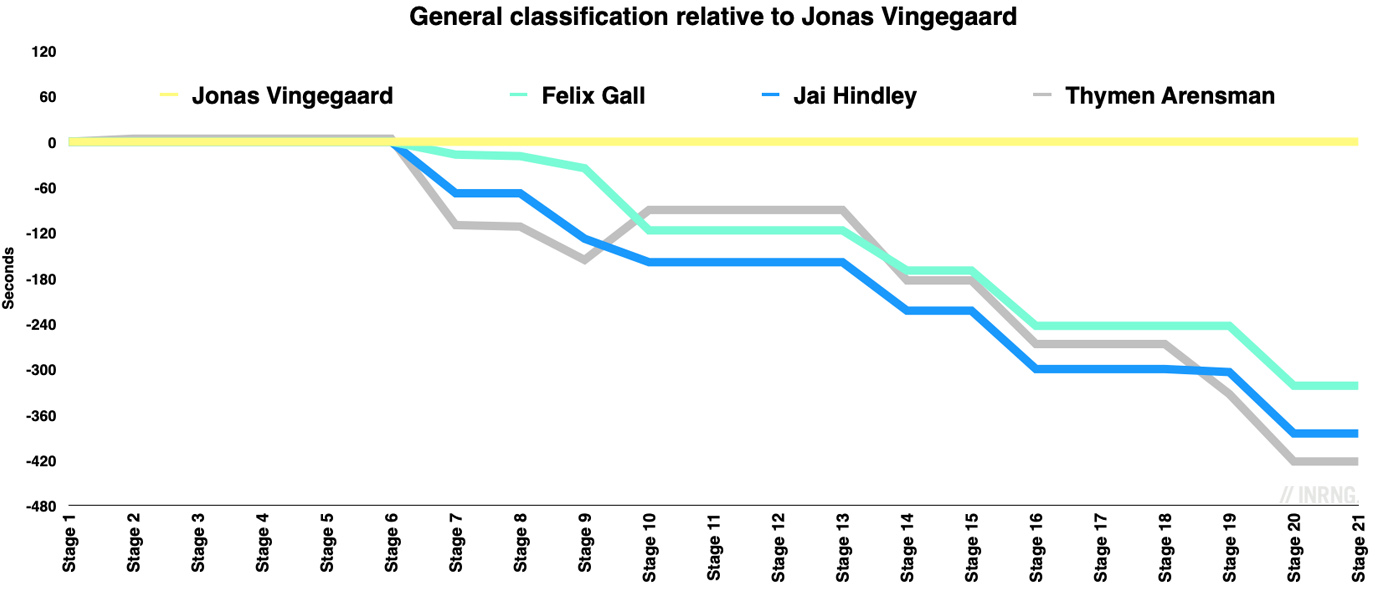
The chart above shows the GC standings during the race relative to Vingegaard. Arensman’s grey line is just above Vingegaard thanks to a time bonus taken on Stage 2. They all fall away on Blockhaus. Stage 10 is the time trial and if Arensman overhauls Gall on the day, Gall is consistently the second best climber while Hindley is almost as regular. Vingegaard finishes four minutes clear.
Vingegaard now has the “triple crown” of winning all three grand tours, a feat Tadej Pogačar has not managed, something his team are keen to point out as they still search for a replacement sponsor. Whatever people think of the man, he’s got a palmarès among the best. But now Vingegaard has ticked the box marked “Giro” it’s quite possible he never returns.

Felix Gall was never going to win but his second place is above expectations. L’Equipe’s Thomas Perotto deftly branded him the “eternal second” as he was always the runner-up in the mountains. He and Decathlon would have signed for this result in Bulgaria, and they’d have signed for it every morning during the race too. The worry was he’d slip up, literally. Perhaps aided by good weather he never made a mistake – unlike in Catalunya back March – and so never lost time because of a mishap. A more upright TT position helped, as did several altitude camps before the race including a last one at Etna, and even having his girlfriend drop by the hotels along the way apparently made a difference too for Gall’s performance and his first grand tour podium.
Jai Hindley finishes third thanks to dependable reliability. Regularly finishing third is no mean feat but he showed no sign of being able to finish second. Team mate Pellizzari was lively and probably over-inflated by the media coverage, he paid on the Blockhaus and then struggled with illness but still 22 and if he glances at Hindley on the podium he ought to see himself there next year.
For all the predictability on GC, the daily stage battles were good, boosted by cheerful weather. Take Movistar’s collective action on the stage to Cosenza, this may not prove a highlight of the season but it was something that provided spice to the stage and for hours on end too: if they didn’t gain, we did. Afonso Eulalio was a revelation even if he’s been quietly tipped for his abilities and we’ll see more from him. The points and mountains competitions were competitive late into the third week.
The Giro is in a bind. If it was a film, the casting director would not be up for any awards. The race struggles to get star names, and if it does then the big name steals the thunder. It’s not an easy trap to escape. The Tour de France is now five weeks away. No doubt we’ll see plenty of Danish flags being waved by holidaymakers but Vingegaard’s biggest fans in July could be the Giro organisers. If he can feel unburdened for the rest of the season with nothing to lose it could be good for the Giro and the Tour alike.